
Capitol Clash: CFC Confronts ‘Anti-Hate’ Bill Built on Undefined Terms
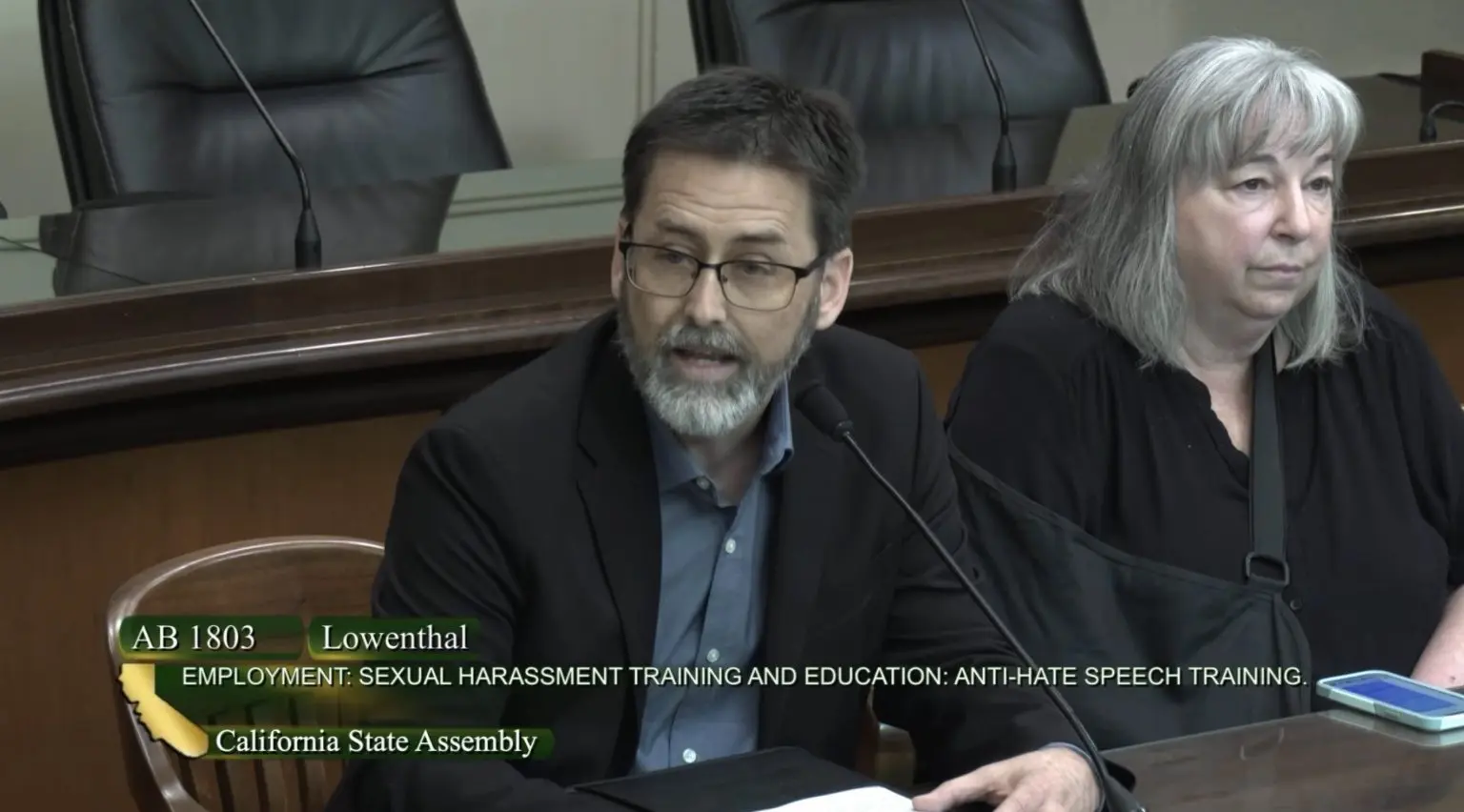
Last Wednesday, the California Assembly Labor and Employment Committee heard testimony on AB 1803, a bill that would require businesses across the state to incorporate “anti-hate speech” training into existing workplace harassment programs. While the bill is framed as a response to rising incidents of hostility, its first hearing revealed serious constitutional concerns and a striking moment of irony from the bill’s own author.
A Bill Built on an Undefined Term
At the heart of AB 1803 lies a fundamental problem: it attempts to regulate something that has no clear legal definition.
California Family Council outlined this concern in its formal opposition letter, warning that “hate speech” is not a recognized category under U.S. law. Without a clear definition, employers would be left to navigate shifting cultural and political interpretations, exposing them to liability while chilling legitimate expression.
Even during the hearing, the bill’s author, Assembly Speaker pro Tempore Josh Lowenthal (D-Long Beach), acknowledged this gap. When asked directly about defining “hate speech,” he admitted the bill currently contains no definition and that discussions are still ongoing with stakeholders about what it should include.
That admission underscored what opponents have warned from the beginning: the state is attempting to mandate training on a concept it cannot clearly explain.
Greg Burt: “You Cannot Regulate What You Cannot Define”
Greg Burt, Vice President of California Family Council, delivered a clear and compelling argument against AB 1803 during the hearing.
“You cannot regulate what you cannot define.”
Burt emphasized that while most people can agree certain speech is hateful and wrong, government power to define “hate” inevitably expands beyond clear cases and begins targeting disfavored viewpoints, especially religious beliefs.
“And this training hinges on a term, hate speech, that has no clear legal definition in state law.”
He warned that in today’s political climate, traditional Christian beliefs about sexuality and gender are increasingly labeled as “hate,” placing people of faith directly in the crosshairs of government-mandated training.
“We see this here at the Capitol. Unpopular religious beliefs about sexuality or gender are labeled as hate, and then groups like ours, who advocate for these viewpoints, are labeled as hate groups.”
Burt’s testimony echoed longstanding First Amendment principles. As the Supreme Court affirmed in Matal v. Tam, there is no “hate speech” exception to the Constitution. The government cannot prohibit or compel speech simply because it is deemed offensive.
“There is no hate speech exception in the First Amendment.”
He concluded with a warning about the true nature of the bill:
“The government cannot compel speech or force employers to promote a government-approved viewpoint. That’s not training. That’s simply compelled indoctrination.”
Other Opposition Highlights Chilling Effects
Burt was not alone in raising concerns. Another opposition witness, Meg Madden with CAUSE, echoed the same fundamental issue: AB 1803 creates a mechanism in which whoever designs the training effectively decides what counts as “hate.”
She pointed out that the First Amendment prevents speech restrictions based solely on offense, and warned that labeling viewpoints as “hate” shuts down meaningful dialogue rather than fostering it.
The broader concern is clear: once “hate speech” becomes a tool of regulation, it becomes a weapon against dissent.
The Irony of the Bill’s Author
Perhaps the most striking moment of the hearing came not from the policy discussion itself, but from a real-world example raised during testimony.
Burt referenced a recent CFC-sponsored press conference in Long Beach, where young female athletes spoke about the discomfort and injustice of being forced to share locker rooms with biological males. According to eyewitnesses, Assemblyman Lowenthal attended the event and made an obscene hand gesture toward the crowd as he left.
“The message of the press conference must have really made the Assemblyman very angry because a couple of the girls told us they saw the Assemblyman flipping off the crowd as he left.”
Burt invited the Assemblyman to clarify what happened.
To his credit, Lowenthal did address the incident during his closing remarks. He did not deny being present or upset. Instead, he explained that his frustration was directed at Republican Assemblymembers Kate Sanchez and David Tangipa, who had participated in the event without notifying his office.
He acknowledged being “very frustrated” with his colleagues, though he denied interacting with the athletes directly.
The moment revealed a glaring contradiction.
Here is a legislator advancing a bill to mandate “anti-hate speech” training across California, while simultaneously defending his own “hateful” emotional outburst toward political opponents at a public event involving teenage girls.
It raises an unavoidable question: if “hate speech” is left undefined, who decides what counts?
And more importantly, will those standards be applied equally?
Compelled Speech and Conscience Concerns
Beyond the immediate controversy, AB 1803 raises deeper concerns for religious liberty and conscience rights.
As CFC’s opposition letter explained, many employers, especially churches, ministries, and faith-based businesses, hold sincerely held beliefs about marriage, sexuality, and gender rooted in Scripture.
Under AB 1803, those same employers could be required to either teach or affirm ideas that directly contradict their convictions.
This is not simply a policy disagreement. It is a question of whether the state can force individuals and organizations to speak messages they believe are false.
The Supreme Court addressed this directly in Wooley v. Maynard, affirming that the government cannot compel individuals to promote ideological messages against their will.
Yet AB 1803 moves California in precisely that direction.
A Chilling Effect on Free Expression
There is also a broader cultural impact to consider.
When speech is policed through vague and subjective standards, people do not become more open; they become more silent.
As seen in educational settings, where similar frameworks have been implemented, a majority of individuals report self-censoring out of fear that their views will be labeled offensive.
Transferring that same dynamic into workplaces will not foster understanding. It will suppress honest conversation.
Employees will learn quickly: it is safer to say nothing than risk saying the wrong thing.
The Path Forward
AB 1803 passed out of committee on an initial vote, with all Democrats voting yes, one Republican, Assemblyman Juan Alanis, not voting, and another Republican, Assemblyman Phillip Chen, voting yes. The next hearing is scheduled for April 6 in the Assembly Judiciary Committee.
The first hearing made one thing clear: this bill is not simply about workplace training. It is about who has the authority to define truth, label dissent, and compel speech.
As Christians, we are called to speak the truth in love (Ephesians 4:15). But truth cannot exist where speech is coerced, and definitions are manipulated.
California does not need more government-mandated ideology. It needs a renewed commitment to the foundational freedoms that allow diverse viewpoints, including religious convictions, to coexist.
For the sake of free speech, religious liberty, and basic fairness, AB 1803 should be rejected.