

Feds Target ‘Wolves in White Coats’ Pushing Gender Drugs-Surgeries, While CA Bill Mandates Coverage

Feds Target Wolves in White Coats 08-20-26
A new HHS report raises allegations of fraudulent billing for transgender procedures on minors as AB 1876 would restrict insurers from denying coverage for those same treatments.
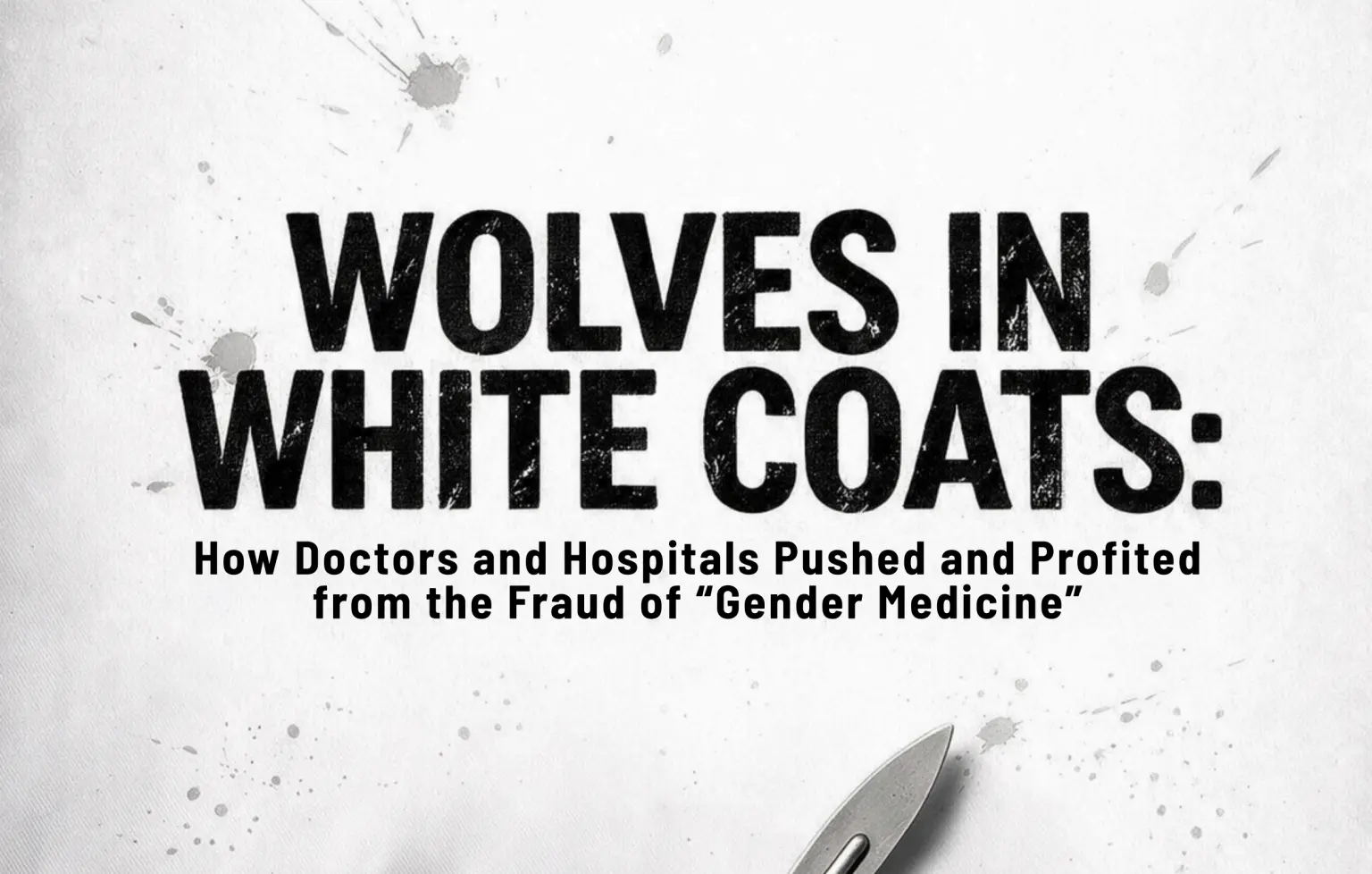
Last week, the U.S. Department of Health and Human Services released a report titled “Wolves in White Coats.” It uncovered evidence that medical facilities were billing sex-rejecting procedures on gender-confused minors using vague diagnostic codes or codes for early puberty. It named hundreds of hospitals and clinics and asked the Justice Department to investigate. At least nine are in California.
Ironically, an Assembly bill California Family Council has been fighting would undermine that federal scrutiny by labeling an insurance company’s refusal to pay for transgender drugs and surgeries as discrimination.
What the report found
When a hospital bills an insurer, it submits a diagnostic code describing the patient’s condition. That code determines payment. After reviewing 10 years of claims data, the U.S. Department of Health and Human Services found puberty blockers billed under codes that say nothing about gender.
Two diagnostic codes are central to the report’s findings. The first essentially means that a patient has an unspecified hormone disorder. The report found more than $40 million in puberty blocker claims billed under that code for children ages 9 to 17. A University of Iowa study of 1,480 patients given that code found only 71 with a real hormone disorder, or 4.7%.
The second code is for a rare condition where puberty starts far too early, before age 8 in girls and 9 in boys. Puberty blockers are the accepted treatment. Hospitals used that code to bill nearly $11 million for teenagers ages 13 to 17. At Boston Children’s, the report found nearly no 11-year-olds given that diagnosis in 2017, 2018, and 2019. In 2022, 50 got it.
Families were “immediately railroaded down a pathway that pushes them into very rapidly and quickly embracing and accepting these irreversible sex-rejecting procedures,” said Dr. Aaron Kheriaty, a psychiatrist at the Ethics and Public Policy Center who contributed to the report. Providers, he said in a short film produced by HHS, “decided more or less just to lie about what they were doing.” The early puberty code served two purposes. “These false diagnostic codes were used not just to circumvent difficulties getting insurance reimbursement, but in states that had state laws that prohibited sex-rejecting procedures [on] minors, this false diagnostic coding was actually used to circumvent state laws as well.” He put the total at “over $47 million in fraudulent billing.”
Health Secretary Robert F. Kennedy Jr. referred the named hospitals and clinicians to his inspector general on Aug. 12. Vice President JD Vance asked the Justice Department to open criminal cases. “Convincing vulnerable children to reject their gender can create patients for life, earning hospitals tens of thousands of dollars in additional revenue per child,” Vance said. “If they have done so intentionally, thereby perpetrating a fraud on Medicaid or on private insurers, they should go to prison.”
HHS calls its own findings “directional signals” needing “verification against the underlying records.” Some numbers come from the Stop the Harm Database, launched by Do No Harm, which opposes these procedures and has legally challenged diversity, equity and inclusion programs in medicine. A referral asks investigators to examine the allegations; it is not a finding that anyone broke the law.
Children Failed by Trusted Adults
Eight patients and parents told their stories in the HHS report and accompanying short film HHS. The testimonials, said host Dr. Brian Christine, the assistant secretary for Health and Human Services, “will shine a light into this dark world of deception, medical malpractice, fraud, and stolen innocence.”
Clementine Breen, a 21-year-old UCLA student, was in eighth grade when her parents were asked, in Christine’s words, “Would you rather have a living son or a dead daughter?” She got puberty blockers at 12 at Children’s Hospital Los Angeles, testosterone at 13, and a double mastectomy at 14. “I have constant joint pain and bone density loss as well,” she said. “They didn’t explain to me the potential lifelong consequences.” Breen wasn’t looking for a transgender identity. “I started seeing a guidance counselor at my school. She started telling me, ‘You might be suffering from gender dysphoria.’”
Californian Layla Jane had a double mastectomy at 13 at Kaiser Permanente in San Francisco. “The testosterone damaged my liver at 14. I have genital atrophy. I have urinary issues. It’s almost like I am a menopausal woman,” she said. Nobody warned her about the daily nerve pain, or that she would keep milk glands with no way to drain them. “My doctors kind of did whatever they felt like.”
Behind every one of those medical bills is a child told by trusted adults that her own body was the problem. No drug and no scalpel has ever turned a girl into a boy.
California Led the Way and Now These Cases Are in Court
Children’s Hospital Los Angeles ran the largest pediatric gender clinic in the country. Between 2019 and 2023, California minors underwent 1,359 of these surgeries, nearly four times as many as Oregon, the next state, and one in four nationally.
HHS has referred the following California medical facilities to the Department of Justice for potential violations of federal law: Children’s Hospital Los Angeles, Rady Children’s in San Diego, Stanford’s Lucile Packard, University of California, San Francisco (UCSF), Kaiser’s Southern California physician group, Kaiser Roseville, Children’s Hospital of Orange County (CHOC), University of California, Irvine, Sharp Rees-Stealy, and Scripps Clinic Medical Group.
Three California families have already sued. Chloe Cole got puberty blockers, testosterone and a double mastectomy through Kaiser between 13 and 17. She sued in San Joaquin County in 2023. Kaiser tried to force the case into arbitration but lost that dispute on appeal last September. The trial is set for April 5, 2027.
Breen sued Dr. Johanna Olson-Kennedy and Children’s Hospital Los Angeles in December 2024. A judge threw it out last October because California’s three-year malpractice clock had run. It was not because the allegations were false, but because she filed too late. Her appeal is pending. A third case, Layla Jane against Kaiser, was dismissed in 2024, and the record was sealed.
California hospitals have been backing away from providing transition-related drugs and surgeries to minors for more than a year. Stanford paused surgeries in June 2025. Children’s Hospital Los Angeles closed its clinic a month later, in July, and Kaiser paused as well. Sutter Health ended the procedures last December, and Rady Children’s followed in February of 2026. The Justice Department wanted records on more than 3,000 CHLA transgender patients and dropped that effort in January after a legal challenge. It subpoenaed similar records from Lucile Packard Children’s Hospital at Stanford in May, and a judge blocked that in July.
Olson-Kennedy ran that CHLA gender clinic for 13 years. She also led a $10 million federally funded study of puberty blockers and then would not publish the results, which showed no improvement in the children’s mental health. She is now president-elect of the American branch of WPATH, which writes the transgender healthcare guidelines for hospitals to follow.
Insurance companies would be accused of discrimination
Neither Governor Gavin Newsom nor Attorney General Rob Bonta has commented on the federal report. Meanwhile, California lawmakers are advancing AB 1876, which would restrict insurers’ ability to deny coverage for many of the procedures now receiving federal scrutiny. It currently sits on the Senate floor awaiting a final vote.
Assemblymember Dawn Addis authored AB 1876. The bill forbids insurance companies from denying or limiting coverage for puberty blockers, sterilizing hormone therapies (cross-sex hormones), double mastectomies, or other procedures sought “for the purpose of gender transition or other gender-affirming care” if the insurer covers those same procedures for other medical reasons. For example, the bill would bar an insurer from denying a mastectomy solely because it is sought for gender transition if the same procedure is covered for another medical indication, such as breast cancer, even if she is a minor.
AB 1876 also tells insurers they cannot maintain any blanket policy excluding coverage for all procedures “related to gender transition or other gender-affirming care.” This may be the bill’s most consequential provision because it strips insurers of the ability to exercise independent medical and actuarial judgment on an entire category of contested interventions.
Californian Luke Healy, whose story appears in the federal report, testified against AB 1876 earlier this year. He was 10 when adults he met online began telling him he was really a girl. School counselors agreed. Kaiser therapists agreed. His parents refused to sign off on hormones, so he got them on his own at 18. Yet by age 21, he stopped.
“I’m here because this bill would have helped further guarantee my destruction,” Healy told the Senate Health Committee. “Older men and women online, both as activists, told me that I was really a girl. They sent me pornographic images, videos, and coached me to dress as a girl. What followed was years of depression, drugs, and alcohol abuse. No mental health provider asked why I believed I was a woman. I said that I was trans, and that was all it took.”
Speak out
Look at the adults failing these minors. School counselors, therapists, surgeons, insurers, medical associations, and politicians all played a part. Every one of those adults was credentialed and trusted. What stopped Healy’s medical transition while he was a minor was a mother and father exercising the authority God gave them.
Now the federal government is asking hard questions about how these children were treated and how their care was billed. California should be asking those same questions. Instead of making it harder for insurers to question or refuse coverage for these procedures, lawmakers should demand transparency, investigate what happened, and put children’s safety first. Every state should take a hard look at its own practices. Our children deserve nothing less.